
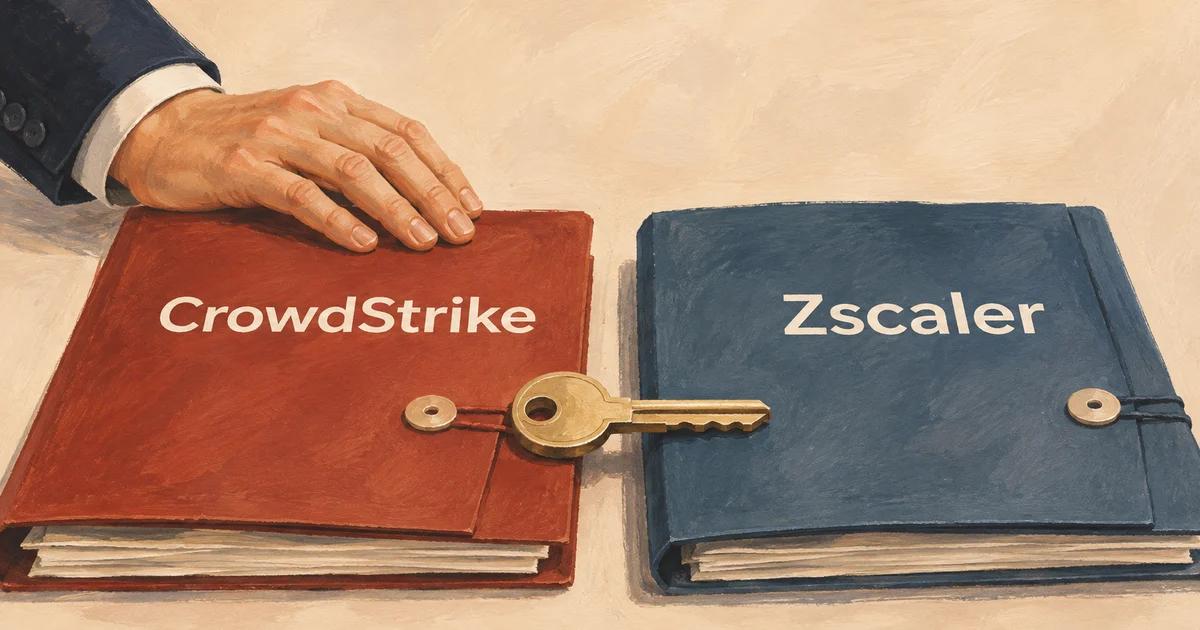
A Norwegian company can buy endpoint protection from one supplier and secure remote access from another, then discover that both depend on the same administrator account. If that account fails, the company's two contracts may not provide two independent ways to keep working.
The planned combination of CrowdStrike and Zscaler makes this a useful moment to examine that question. On 23 November 2026, the companies announced an agreement for CrowdStrike to acquire Zscaler in an all-share transaction valued at approximately $43.9 billion. The transaction is not yet complete. The companies' announcement says completion requires shareholder and regulatory approvals and is expected in the second half of the company's fiscal year ending January 2028. It may be delayed or not completed.
For Norwegian management teams, the decision is not whether to react to a headline by changing vendors. It is whether the security arrangements they already depend on will still work when a shared component, administrator or supplier is unavailable. A short dependency review can support a purchasing decision today without predicting the outcome of the deal.
Integration can help, but it changes the questions
CrowdStrike provides endpoint and other security services. Zscaler provides cloud-based access and network security services. The companies say their proposed combination would bring these capabilities together and help protect AI use. These are the companies' plans, not independently demonstrated results for a particular customer. The announcement does not establish that their infrastructure has already been merged, that prices will change or that a Norwegian customer's service will be affected.
A more integrated service can make sense. A small IT team may gain a clearer view of related alerts, fewer interfaces to maintain and a simpler support relationship. Separate products also create work: teams must configure the connections, resolve conflicting alerts and ensure that somebody follows up. Waiting for a perfect architecture can leave actual gaps unaddressed.
The trade-off is dependence. If several controls rely on the same identity service, management console, update process or support provider, a problem in that shared component can affect more than one layer of protection. Separate company names do not establish technical independence. Conversely, one supplier can operate services with meaningful separation. Ask what is shared in the specific configuration, rather than assuming either answer from ownership alone.
An update can interrupt the service it protects
The July 2024 CrowdStrike outage illustrates why a security provider belongs in a continuity plan. CrowdStrike's incident report describes a faulty content update that caused affected Windows systems to crash. It was a software update failure, not a cyberattack. The event is not evidence that Zscaler was involved or that the planned acquisition will produce a similar incident.
The lesson for a buyer is more specific: a tool with broad access can be important to recovery as well as prevention. Ask how the company would identify affected devices, contact the right support team and restore a critical service if that tool or its management channel could not be used. Do not disable security protections merely because of a hypothetical problem; any isolation or emergency change requires a risk assessment and a responsible decision maker.
Follow one service through its dependencies
Consider a hypothetical Norwegian wholesaler whose employees use remote access to reach its order system. An external IT provider manages employee devices, the login service and security software. The wholesaler wants to keep receiving orders if an access or security service becomes unavailable. This is a worked example, not a real customer or incident.
Management can ask its IT provider to map that one service on a page:
- The business function: What must remain available for employees to receive, confirm and dispatch orders? Which parts are essential outside normal office hours?
- The path in: Which identity service, administrator accounts, network access and endpoint controls are needed? Which of these are shared by the apparent alternatives?
- The people and suppliers: Who operates each component, who can authorise a change, and who can help if the regular provider or its support channel is unavailable?
- The fallback: Is there an approved, tested way to continue essential work with appropriate controls, or must operations pause? Who can activate it, for how long, and how will orders be reconciled afterwards?
- The evidence: When was the arrangement last exercised, what did the test cover, and what remains unknown? A contact list or a contract clause alone does not demonstrate recovery.
If the answer is that the same login system controls both the regular route and the proposed backup, the team has found a dependency worth addressing. A different login route is useful only if it is appropriately protected, available to the right people and tested. A fallback may mean a limited manual process rather than a second software subscription.
Ask before the next renewal
The buyer should ask its supplier and IT partner which services and subcontractors are involved in its actual setup, how material changes will be communicated and what help is available during an incident. Check the relevant agreement for notice, support, access to logs and the practical cost of changing the arrangement. The terms can differ by product and contract; an acquisition announcement does not answer them.
Norway's National Security Authority notes that outsourcing and cloud services can improve security when they provide access to larger professional environments, particularly where internal resources are limited. It also describes risks and dependencies that need attention. Its advice is guidance, not evidence that every Norwegian company should operate its own systems or buy duplicate products.
The proportionate choice depends on the business. A firm whose remote access is helpful but nonessential may accept a short outage and provide a clear manual process. A firm that must maintain a critical service around the clock may need a tested alternative, more support capacity or contractual assurances. Both should understand the effect on customers and the limits of the fallback.
What the board needs to see
Management owns the supplier review, contracts, configurations and exercises. The board should ask for the business impact of a major dependency, the evidence that the proposed response works, any material gaps and the resources or risk decision that require its attention. Directors do not need to select software products or operate the access controls.
At the next relevant meeting, ask management to demonstrate the dependency map for one critical service and report one unresolved shared point of failure. Connect the result to the existing guide on supplier updates and incident response and the board's cyber risk reporting. The aim is to use integration where it helps while knowing how the business will continue when it does not.
Sources checked on 28 November 2026. The wholesaler and its arrangements are hypothetical. The acquisition remains subject to conditions. Recommendations and interpretation are the author's analysis. The illustration is AI-generated.