
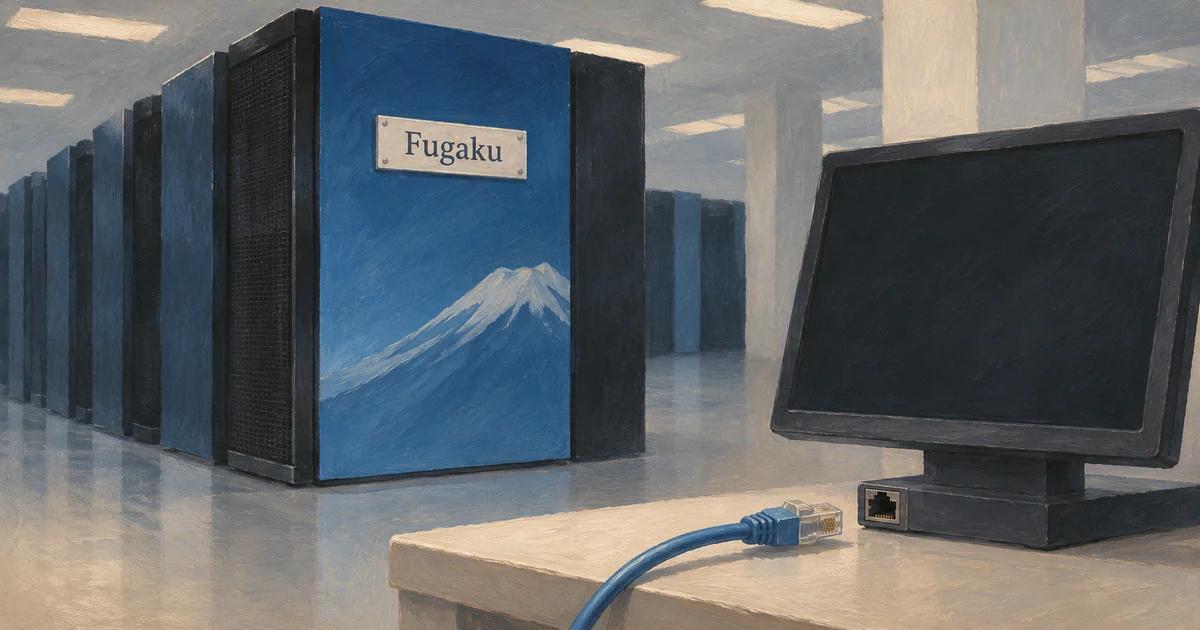
A status page can tell customers that a service is working. If the system behind that page can also reach administration tools, customer data or stored credentials, a problem on the public side can become a much larger incident. A recent breach at Japan's Fugaku supercomputer shows why a management team should ask its supplier what sits behind an apparently simple dashboard.
The decision is practical: which information must be available publicly, and which connections can be removed or restricted without losing the service people depend on? A Norwegian business does not need a supercomputer to face that choice. It may run an AI service, an ordering system or a customer portal that depends on a separately maintained status page.
What RIKEN has reported
Fugaku is operated by Japan's research institute RIKEN and is used for research and computing. In its first incident notice, RIKEN said an outside party reached Fugaku's internal operational network through a publicly accessible page showing its operating status. The activity occurred from 10 to 13 November 2026. RIKEN said the exact method of entry was still being investigated. It confirmed unauthorised access on 13 November and suspended Fugaku and external access early on 14 November.
The update on 20 November reported evidence that credentials for external systems had been collected and taken from some users' home directories. These included 430 private keys, 197 protected by passphrases and 233 without them. RIKEN reported evidence of external connections using some credentials, but said it had not identified other misuse. It was contacting affected users and asking them to revoke and replace keys at each external service.
These are RIKEN's findings as of 20 November, not a complete final account. They do not establish that every user's research data was stolen or that AI caused the breach. RIKEN said it used AI and other tools to help analyse logs. It also said it would separate public services from the administrative network and rebuild servers before deciding when Fugaku could resume operation.
Follow one status page all the way back
Imagine a Norwegian company that gives customers a public page showing whether its AI document service is available. A software supplier maintains the page, a cloud provider hosts it and the company's IT partner manages accounts. The company and configuration are hypothetical, not a description of Fugaku or a real customer.
The page may need public access. Its connection to the systems that collect operational information does not automatically need the same access. Ask the people who operate the service to trace the path from the public page to its data source, administration tools and any other systems it can reach. Include supplier support connections, cloud accounts and automated credentials. A diagram is useful only if the owners check it against the actual configuration.
For each connection, record the purpose, the owner, who can change it and what happens if it fails. Then choose an appropriate design. One option is to publish a limited, delayed copy of health information to a separate service, while keeping administration and sensitive operational data elsewhere. Another is to restrict access to an operational dashboard to authorised people through a protected route. Each choice needs testing: a public page that is too stale can mislead customers during an outage, while a private page may leave customers without information.
NSM recommends controlled network traffic, suitable access controls and regular removal of forgotten services and accounts. Its advice must be adapted to the actual system. A VPN alone does not establish that the service is safe, and a public website cannot simply be treated as an internal page.
If a system is breached, where do its keys lead?
A private key is a credential that can let a person or a program authenticate to another service. The question is not only where it is stored. It is also which external systems will accept it, who can revoke it and what will stop working if it is withdrawn.
Ask the technical owner to inventory credentials used by the status service and the systems around it. Remove unnecessary access, limit each credential to the work it needs and use an appropriate protected store. Plan how to revoke and replace credentials at the receiving services, including those managed by a customer or another supplier. Do not put secret key material in a shared spreadsheet or board paper.
A passphrase can add protection, but RIKEN's count is not evidence that every protected key was usable or unusable by an attacker. Nor does finding a key prove that every system it could reach was compromised. The incident team must investigate the specific key, logs and receiving systems. When there is evidence of compromise, a response team may need to revoke access immediately even if doing so interrupts work; the incident plan should identify who can make that call.
Test a decision, not just a diagram
With the supplier, run a short tabletop exercise: assume the public status service has been compromised on a Friday evening. Can the team identify the owner and the other services it can reach? Who can isolate it safely, and how will customers receive updates? Which credentials must be revoked at other providers, and how will those owners be contacted? Who preserves the logs and decides when a rebuilt service is safe to reconnect?
Record unresolved connections, the person responsible and a deadline. A discussion does not prove a technical control works. Arrange a separate, authorised test with the people responsible for the service, and assess the effect on monitoring and customers first. Do not disconnect a live production system as an improvised exercise.
Smaller businesses can start with one important public service and ask their existing provider for help. The work has a cost: a separated status service must be maintained, checked and paid for. But waiting also has a cost if a preventable compromise interrupts customer work. Choose a first step that is proportionate to the service and the information it can reach.
What management and the board need to know
Management owns the inventory, supplier coordination, testing and incident plan. For a material service, the board should ask whether management knows which public systems can reach sensitive operations, whether the company can inform customers during an incident, and whether it can revoke important external access promptly. It should receive the major gaps and a plan for closing them, not a list of secret credentials.
NSM's Allvis NOR maps internet-exposed services for eligible organisations under the Security Act and organisations that own or manage critical infrastructure or services. It is not a guarantee of security or a service available to every Norwegian business. Others can ask a qualified provider to map their own exposure with authorisation and compare the results with the inventory.
The guide to supplier access addresses a related question: how a supplier's access can expose its customers. Here the starting point is a public-facing service and the paths behind it. The cloud outage guide helps management plan how work continues if a service is unavailable. Contact Jonas to discuss digital resilience and supplier responsibilities.
Sources checked 22 November 2026. The Norwegian company and exercise are hypothetical. RIKEN's investigation was ongoing in its 20 November update. Recommendations are the author's analysis. The illustration is AI-generated.